Monday, January 16, 2012

1st Warmachine/Hordes Tourny (or why I like gaming)

This past Saturday I participated in my first public Warmachine/Hordes event. This was billed to be a Hordes Domination event which is promote the Hordes latest expansion. However, I'm a new player to the game and at this I only have one faction, the Protectorate of Menoth. But I still wanted to go learn more about the game. In addition,  my two sons (who also play) wanted to go and my local gamer friend, Geekly , was also going. So, off to the LGS we went.

Now this post isn't going to be about lists or the battle report because for non-Warmahordes players, that would be pretty boring. But instead what I want to talk about the are the other players in the tournament.

I'm a huge proponent of gaming (cards, boardgames, RPGs, minis) for the fun and social interaction with other people. Social media, online games, etc. are causing us to spend less face time with friends and family. Gaming forces people to sit across the table from each other and interact. This is a major appeal to all gamers. 

So when we got the store, we didn't know any of the other four players there. But each one of them immediately introduced themselves and welcomed us. When it was time to start the tournament, we had to inform the tournament organizer, that we only had 15pt armies and this was scheduled to be a 35pt tournament. Instead, of saying we can't play, every other player willingly without hesitation offered to play a 15pt tournament instead. Each of them had already built their lists (armies) but didn't mind at all doing another list for 15pts. This would allow me and my sons to play. Now with everyone's lists ready to go, we drew numbers to see who would face who. The tournament would consist of three rounds with the winner being the person with the best record.

So during the three rounds, we played people that had been playing this game for years. While we had a basic foundation of the rules there were many things we had questions about. Every person was very helpful taking time during the game to explain rules, strategies and gave us all the time we needed to make our moves. I had to play the guy who ended up winning the tournament and he was very helpful during our game. After we were done (and yes, he crushed me) he gladly took another 5 minutes to explain strategies that would help me in future games. Both my sons experienced the same thing with people they played against.

Speaking of my sons, my 15 and 9 year old were welcomed and treated like any other player. They were treated with respect and also offered help during games. In addition, everyone watched their language around my 9 year old which sounds like a small thing, but it shows a level of maturity that isn't seen much anymore.

After the tournament was over, we talked about the great time we had and we learned so much about the game. 

This is a typical example of the gaming community. Gamers love to talk to other players about the games, the rules, the strategies. That creates new relationships, builds the community and helps strengthen the hobby it self.

I try to do the same thing with other games I play. I take time to teach someone the rules, be patient with their questions, and provide advice during the game. I know by doing this, they will enjoy the experience and want to play again. It's not about the winning or losing, it's about shaking your opponents hand at the end of the game and thanking them for the enjoyable experience.

Ok, ok...for those who want to know. My 15pt list as the Protectorate of Menoth Battlebox plus the Choir of Menoth and Vassel of Menoth. I was 2-1, winning against Cryx and Legion and losing to Khador. And even though I didn't play a Hordes faction, because of my record I got this cool Trollbloods token

Thursday, January 12, 2012

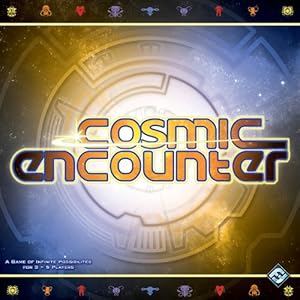
1st Time Play: Cosmic Encounters

In my hometown of Charlotte NC, there is a Meetup Group dedicated to strategy boardgames. A group of 20 or so will gather in a local restaurant and play games for a few hours. Typically 3-4 games are going at one time so there is always something of interest for everyone in attendance. At this particular meeting, Cosmic Encounters was one of the featured games and this was a game I've been wanting to try for awhile because it is very popular, well rated and the #1 game on The Dice Tower's Top 100 game list - 2011 Edition.


Cosmic Encounter is an old game compared to most popular strategy games out today. It was released in 1977 then picked up Fantasy Flight Games and re-released in 2008. At it's core, it's a Sci-Fi themed game where you represent an alien race whose goal it is to conquer planets. Three to five players (six with an expansion) get 5 planets and 20 ships to place on their planets (4 per planet). Each player gets a hand of cards that have numbers on then, or an 'N' (Negotiate cards) or artifact cards (which I'll cover later). During a players turn, the player will flip over a card in a separate deck that has a color on it. The color represents the player that is to be attacked. The attacking player takes up to 4 of his/her ships and moves them in front of one of the defenders planets. Now the attacking player can ask specific players if they want to help the attack. The defender can then ask players if they want to help to defend. One at a time, the players who were asked to help can dedicate up to four of their ships. If they were asked by both players to help, they must make a decision who to help or not help at all. Once all ally ships have been put into place for the attacker and defender, the attacking and defending players will then play a card from their hand face down on the table. At the same time, both cards are flipped over. The numbers on the card are added to the ships in the battle. If the attacker exceeds the defenders value then it inhabits a planet by placing a ship on it. The allies that joined the attacker also get to place a ship on the planet and inhabit it. If the defender wins, he keeps the planet and the allies that help defend get to draw cards equal to the number of ships they committed to defend. The losers in the battle must move their ships to a zone in the middle of the table. Those ships can no longer be used but at the beginning of a players turn, one ship can be reclaimed from the zone. If one of the players plays a Negotiate card, that means they are basically conceding the battle (waving the white flag). But if they do so, they get to randomly take 4 cards from the other players hand. If both players play Negotiate cards, it's a draw and they have a minute to negotiate an agreement such as trade cards, or agree to allow the other player occupy one of their planets. If no agreement is made, then each player loses three ships. The goal of the game? Be first player to inhabit 5 planets..


That's the rules in a nutshell. But like any good game, there is some mechanic to 'break' the basic rules. That is done by the alien race you play as. At the beginning of the game, each player gets two random alien race cards. The player picks one to be for the game. Each race has certain abilities such as The Pacifist, if they play a Negotiate card they automatically win the battle (unless the other player plays a Negotiate card then the standard rules apply). The Oracle, while in battle, the other player must play their card face up so you can see what it is. Other aliens earn special rewards if you win, keep allies from losing their ships. etc. Their are 50 alien races overall and even more in expansions. Another way to break rules is with the artifact cards which can be used during games to nullify a aliens ability, or nullify a card someone else plays.


So while the game is simple, the fun of the game comes in the player interaction. There is constant talk of who is going to help who. As one player takes a lead, others come to the aid of the defender to keep the leader from taking another planet. Or sometimes asking others to help defend could be bad because you don't want them to have any more cards. Or the attacker taking allies means giving other players planets. As a result, there is no player downtime. Every player can be involved in every turn.


The game can take 1-2 hours depending on how cutthroat the game becomes. But so much is going on, you don't even realize how much time has passed.


Another member of my smaller gaming group also played that night and we both agreed that for our group, this game could be a lot of fun. With so many alien races, each game will be different, thus the strategy will be different. I can see how The Dice Tower ranks this game so high year after year and I look forward to playing again.

Monday, January 9, 2012

My Most Anticipated Games of 2012

Each year there are a few games that I keep my eye and get excited about. While I'm sure there will be some more announced I haven't heard of, here are a few that are really sparking my interest.


First up is World of Warcraft: Clash of Champions. This game is from Cryptozoic, the publisher of the WoW TCG. When WoW TCG was first released by Upper Deck, I was heavy into it. I enjoyed the theme, the art, and most importantly the gameplay. However, as more and more sets kept coming out, I just couldn't keep up. It got to the point I was so many sets behind that I just put it aside. However, with Clash of Champions, this is a deck building game and not a collectible game. Everything you need is in one box and no need to buy anything else. I've come to really like the deck-building genre and WoW universe is very rich with lore and characters. This is a no-brainer buy for me.


At GenCon, I got the opportunity to test play Mage Wars. This is a card/board game where powerful mages face off against each on playing field broken into two rows of four squares. The appeal to me of this is that even though its a card game, there is no draw deck. All of your cards are in a book and you play card directly from that book. No luck involved when it comes to card draw. If you need it, you have it. The company has done a lot of playtesting at Cons over the past year and player feedback is very important to them. So I have high hopes for this game. Plus, I'm in one of their pictures on their website (Rock Em Sock Em Robot guy), so that's a bonus :-)


This past year I got into the miniature-battle game, Warmachine. One thing that drew me to that game was the lore. It is very steam-punkish with some magic mixed in. There are several warring factions in the Iron Kingdoms each with their own backstory and larger than life characters. The company that makes Warmachine, Privateer Press, recently announced they are releasing a new pen and paper RPG called Iron Kingdoms. I will admit that I never really got into RPGs because they were intimidating to me because of all the books and guides that exist. It just seemed like too much to buy and learn. With Iron Kingdoms, this will be a new system released with only one or two. So getting in on the ground floor of a game is less intimidating and will make the game easier to learn. Luckily, I have several other friends who are also interested in this IP so it won't be hard to find people to play with.


Those are the three main new properties I'm keeping an eye on this year. There will be some new expansions to some existing game I play that I will get. But I'll talk about those as the year goes on.


So what new games are you looking forward to?

Sunday, January 8, 2012

1st Time Play: Mansions of Madness & Kingsburg

My brother-in-law's birthday was this weekend so he invited our family down to Augusta to have a gaming day. As a Arkham Horror fan, he was anxious to teach us Mansions of Madness and also wanted to show us a fun, lighter game called Kingsburg. First, Mansions of Madness.


After a lengthy game setup, four of us sat down to take on the roles of investigators to work together to play against the Keeper (a GM type role played by my brother-in-law). A tile map was assembled  for us to explore based upon a scenario and we needed to look for three clues to lead us to the objective we were trying to meet. The Keeper also has an objective and he has the advantage of knowing his objective and ours.


The game is basically moving around the different areas of map exploring, fighting monsters that the Keeper spawns against us and solving puzzles that are tile based puzzles such as putting together a picture or connecting tiles with wires on them from point A to point B to turn on the power that had been lost in a room. It is very much a co-op game with a lot of interactive between investigators as all of the investigators have different attributes. Some are better at fighting, some at solving puzzles, etc. Once you determine your objective, you are racing against the Keeper to finish the objective before he finishes his.


Even though the game took 2-3 hours, it moved very fast because there wasn't a lot of downtime. The interaction kept you involved with discussion and planning. And the overall game felt like a pen and paper RPG mixed with a boardgame (which is what I heard Fantasy Flight was going for). As such, I very much liked the game and look forward to playing it again.


Next, Kingsburg


Kingsburg is also from FFG. Even though it's been out for several years, I had never heard of it so I wasn't sure what to expect. It ended up being a medieval theme resource management game somewhat along the lines of Settlers of Catan with the Cities and Knights expansion. You have 5 turns with each turn being considered a year. Each year is split into 8 segments with 4 of those being seasons for harvesting resources and using resources to build buildings or train soldiers. There are too many buildings to list here but the buildings give you victory points (which is what you need to win the game) and bonuses within the game like bonuses to your soldiers, making buildings cheaper to build, etc. After the 5 turns the person with the most victory points wins.


Once again, I ended up liking this game too. It takes an 1 to 1.5 hours to play, the rules are easy to learn and there isn't a lot of downtime because some of the phases have all the players doing things at the same time. It definitely has a eurogame feel to it and I would consider this as a good gateway to non-gamers (much in the vein of Catan and Ticket To Ride).


I'll eventually do full reviews on these games and give scores for how the wife and boys felt about it. But I prefer to play games at least twice before doing a review.


I think we may need to start a tradition where on family birthday weekends we have gaming days. It's a great way to have fun with the family and learn some new games to boot. 

Wednesday, October 19, 2011

Welcome


Crit and Miss is blog dedicated to tabletop gaming. I will be providing reviews, news and discussions on various types of games including board games, card games, miniatures, and role-playing games.


While there are many other gaming blogs out on 'the webs', my focus will be from the point of view as a husband, parent and friend of gamers. As such I will focus more on using games to develop friendships and build relationships. With more and more people getting caught up in online social media, I want to do my part to make sure face to face time doesn't become passe.


If anyone would like to submit reviews of games to be posted on the site, feel free to contact me as I would like to have as many contributors as I can.


For more on my background, visit the About page for some more personal insight.

About


Let me start off by saying, I'm a gamer. Since I was a kid I've played board games, card games, and video games. And all these playing all these types of games are best played with friends and family. In the 90s, when online gaming took off, I was right there with it. I remember having to tell the wife to hurry up and get off the phone (you remember dial up modems, right?) so I could play some Half-Life or Starcraft with my friends. I thought this was about the best experience you could having in multiplayer gaming. To be able to sit a home and play games with others online. I was hooked..from FPSs, to RTSs, to MMOs. I could sit down anytime I wanted at my PC or Xbox, find some friends online and engage in some 'social' gaming.


Then something happened in late 2001. I was introduced to a type of game called collectible card games (CCGs). This type of game had been in the market for about ten years, but I had never looked into it. Without going into too many details, this type of game involves buying cards, building decks and playing against other people. The particular one I got into was Lord of the Rings. I introduced it to a friend and he too was instantly hooked. Over the next couple years, we bought cards, traded cards and got together anytime we could to play. We'd play at each others houses, meet a libraries and even fast food restaurants. All of the sudden, sitting at my PC and playing games online wasn't as much fun sitting across the table from someone and playing a game in 'real life'.


The Lord of the Rings CCG is no longer published but I replaced that game with several other CCGs and more recently got into board gaming. The board games we play aren't the classic board games such as Monopoly, Risk or Sorry. Instead they are more non-mainstream board games that have been gaining popularity over the years. These game ranges in different styles such as 'european' style, resource management, strategy, and co-op. We've played many games over the years and while some have stayed in our game night rotation while others were a one and done, one thing does remain. I would still much rather sit with my family and friends and engage in this type of gaming over the online gaming that comes from the PC,  Xbox360, PS3 and even Facebook.


So that's what this site is all about. I want to provide people reviews with some games that I've played with family and friends that will provide hours of enjoyment, provide social interaction and even require a little brain power. These reviews will be tailored towards hardcore gamers, casual gamers and even children.


Real life gaming is still a great form of entertainment that can build relationships, provides hours of laughs (and frustrations), and even making us use our 'thinking games' more so than just staring at the TV or PC. While I still enjoy video games, it's no replacement for personal interaction. I am a proud father of three sons and they also enjoy video games, but I want them to appreciate what comes from sitting with other people and having a good time. I think it's too easy to replace real social interaction with online alternatives such as instant messaging, texting, online chats, etc. Sitting with friends and family around a table and holding cards or board pieces while strategizing over a game are times that you'll love and look forward to.

Wednesday, October 12, 2011

Tsuro

Tsuro

Overview:

Tsuro (Calliope Games) is a easy to learn strategy game that consists of nothing more than laying a lined tile down on the game board, then taking your token and following the path on the tile onto other tiles until the path ends. The goal is to keep your token on the board and while trying to cause other players token to follow a path off the board. The last token on the board wins.

Components: Game board, 36 tiles, 8 game tokens

Number of Players: 2 - 8 players

Average Game Length: 20 minutes

Gameplay:

Tsuro is game that can be taught and played in a matter of minutes. It's very easy to understand the rules thus making it a great game for children and those who don't want to spent a lot of time learning games with 40 page rule books (like Starcraft: The Board Game). Because there are so few game pieces and games are quick, it's a good game for pulling out of the closet and playing at a moments notice. There is downtime between turns, but the pace of the game moves pretty quickly so you won't spend too much time waiting on others to make their move.

Hardcore Score: 5

This game is good in short bursts, but it's not something a hardcore gamer is going to play hours upon hours. There isn't a lot of strategy involved and your best plans can be thwarted by someone throwing down a random tile and totally messing up your path.

Wifecore Score: 7

Due to the quick setup and easy to follow rules, this is a very good casual game. In addition, my wife likes it because its a great social interaction. You don't have to spend a lot of time planning out your next move so during your downtime you can chit-chat with everyone around the table.

Kidcore Score: 9

Of all the games I've played, this is by far one of the most kid-friendly. Probably anyone ages 5 and up can play because there are so few rules, no reading is needed, and you don't have to hold many tiles in your hand. Now a 5 year old may not be able to plan their moves in advance. But it's easy to understand that your piece follows the path until it can't go any further. Highly recommended for kids.